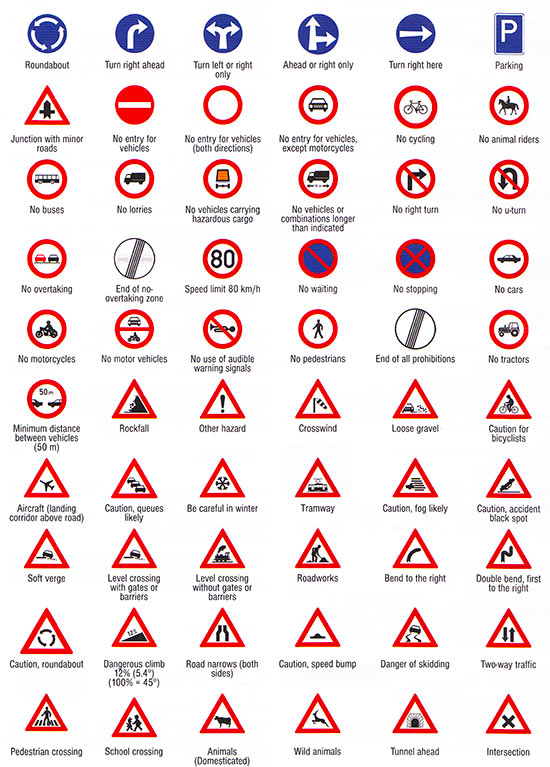
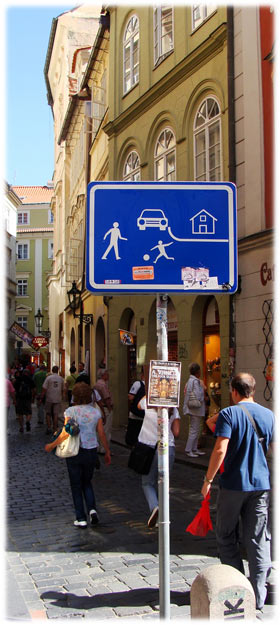
 If you plan to drive, know that a driving licence issued in any EU country is valid across the whole of the EU, Czechia included. A licence from outside the EU is valid for a visit only together with an International Driving Permit issued under the 1949 Geneva or 1968 Vienna convention – American drivers in particular need one. A UK photocard licence is accepted on its own. If you move here (permanent residence, or temporary residence for more than a year), you must exchange a non-EU licence for a Czech one within three months.
Always carry your driving licence (plus the international permit if you need one), your passport or ID card and the car’s registration certificate; rental cars come with their papers. Since 1 October 2024, Czech-registered cars no longer need a paper green card inside the country, because the police check insurance online.
Before you set off, make sure you are completely sober: the Czech Republic has zero tolerance for alcohol at the wheel, and the police can breathalyse any driver on the spot.
Rules of the Road
The Czech Republic follows the usual continental rules: drive on the right, overtake on the left and, where there are no signs, give way to traffic coming from the right.
- Speed limits: 50 km/h in built-up areas, 90 km/h outside them, 110 km/h on expressways and 130 km/h on motorways (80 km/h on motorways and expressways inside built-up areas).
- Lights: dipped headlights or daytime running lights must be on at all times, day and night, all year round.
- Seat belts must be worn in every seat where they are fitted.
- Children who weigh no more than 36 kg and are no taller than 150 cm must travel in a child seat that suits their weight and size. A rear-facing child seat must never be used on a seat with an active airbag.
- Phones: you must not hold a phone or any other device while driving – hands-free only.
- A right turn on red is allowed only where an extra green arrow lights up next to the red light. You must then give way to traffic coming from other directions and must not endanger pedestrians who are crossing.
- A yellow diamond sign marks the main road: traffic on it has priority.
- Trams: pass a tram on the right unless a sign allows you to pass on the left. A tram that signals and turns across your path has priority. In town, when a tram or bus stops at a stop without a passenger island, you must stop behind it and wait until the people getting on and off have crossed.
- Pedestrians on zebra crossings have priority – you must not endanger or hold them up.
- Winter tyres are compulsory from 1 November to 31 March whenever there is snow, ice or frost on the road, or it can be expected.
- If you stop because of a breakdown or accident and get out on the road, you must wear a reflective vest. Place the warning triangle at least 50 m behind the car, or 100 m on a motorway.
On the motorway you may overtake only on the left – but this rule is regularly flouted.
Reporting Car Accidents
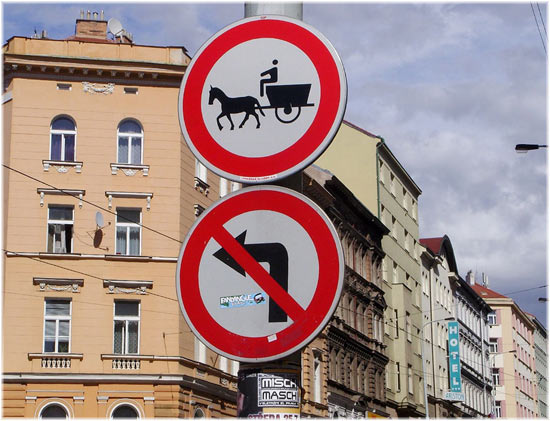
You must call the police (158, or 112) if anyone is injured or killed, if the damage to any one of the cars (including what it carries) is clearly more than 200,000 Kč, if other people’s property is damaged (a fence or a street lamp, for example) or road equipment, or if you cannot clear the road yourselves. In those cases, do not move the cars until the police arrive and stay at the scene. If the cars have to be moved – to help someone who is injured or to let traffic, especially buses and trams, through – first mark the position of each car on the road (chalk or lipstick will do) or take photos.
After a minor accident where none of this applies, you do not need the police, but you and the other driver must fill in and sign a joint accident report (the European accident statement – check that your car has the form). It must give the place, date and time, the cause and course of the accident, the people and vehicles involved, and a sketch or photos. If you cannot agree on what happened, call the police. In a rental car, always tell the rental company straight away as well.
For a breakdown, call ÚAMK road assistance on 1230; its dispatchers answer day and night. On motorways you can also use the emergency phones by the road – the small arrows on the kilometre posts point to the nearest one.